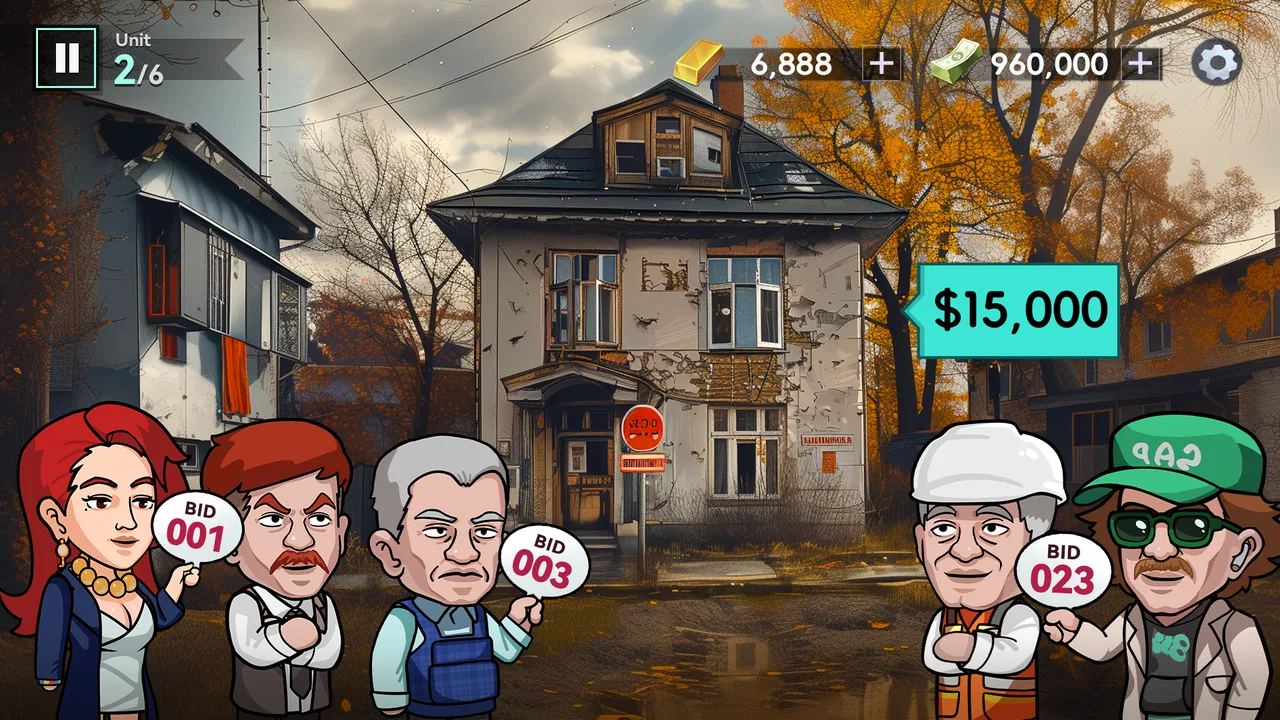
Bid Master : auction tycoon
- 4.4
- Rating
- 10.00M
- Installs
- Free
- Price

 Analysis by App-foxy
I went into Bid Master expecting a light auction game, but its appeal comes from the way it turns a simple bid into a small chain of decisions. You enter an auction, judge whether the contents are worth the risk, spend money to secure the lot, and then try to turn what you found into progress for your pawn shop. That basic action-and-consequence structure makes it easy to understand within minutes, while still giving each session a reason to continue.
This is a free simulation game from Hydodo, aimed at players who enjoy management without the heavy spreadsheets found in more serious tycoon games. Its store summary points toward storage auctions, pawn-shop management, and becoming an auction tycoon, and that description matches the central fantasy well: buy uncertain goods, make sensible choices, and build momentum from what you uncover. The game is available for everyone, with support for Android 8.0 and later. It was released on August 6, 2024, and the current version is 0.8.1.
From the first bid to the next session
I use this section to look at the handoff between one auction and the next: how I can turn a result into a sensible stopping point rather than rushing straight into another bid. A small pause to check what the shop needs helps keep the loop deliberate, especially when I’m playing in brief bursts.
You May Also Like

 Blood Strike: 2.5 Anniversary
Blood Strike’s Loadouts Turn Every Drop Into a Tactical Gamble
A close look at Blood Strike’s custom loadouts: how fast access to signature weapons reshapes its battle royale rhythm, rewards preparation, and narrows the gap between fights.

 Pandora - Music & Podcasts
Pandora’s Music Is Easy to Start, but Harder to Recover
Pandora’s strength is its low-effort path from a seed to a station. Its weak spot is how much confidence it asks you to place in connection, setup, and quiet recovery.

 8 Ball Pool
 Is Built on Rivalries, Rematches, and Routine
A close look at the rivalries, rematches, shared routines, and unanswered safety questions that turn a quick pool match into a persistent mobile community.

 Samsung Music
’s Quiet Strength Is Playing What You Already Own
Its reach comes less from spectacle than from dependable access to a personal library. That simplicity is both the app’s strongest retention engine and its ceiling.

 AccuWeather: Weather Radar
AccuWeather Review: A Quick, Clear Forecast for Everyday Decisions
For everyday plans, the best forecast is the one you can understand quickly. AccuWeather makes rain timing, radar, and local conditions easy to act on, with a few trade-offs.

 Hill Climb Racing
Why Hill Climb Racing Still Turns Crashes Into One More Run
A tiny car, a bumpy hill and one more upgrade: Hill Climb Racing keeps resurfacing because its simple chaos makes every near-miss feel personal.
More From Our News Desk



The first action is simple, but the risk matters
The most important decision in a storage-auction game happens before the reward: deciding how much uncertainty I am willing to accept. A lot can look promising, but a promising impression is not the same as a profitable purchase. That gap between appearance and outcome gives the opening action its tension. I am not merely tapping a button to collect a guaranteed prize; I am committing resources before I know whether the decision will help my shop.
That makes the bidding stage more interesting than a standard idle reward screen. I have to think in terms of trade-offs. Spending aggressively may give me access to a better opportunity, but it also leaves less room for the next auction. Holding back protects my funds, yet it can mean missing an item that would have moved the shop forward. The useful question is not “Can I win this lot?” but “What will winning this lot let me do next?”
I found that mindset especially helpful during short play sessions. If I only have a few minutes, I can still make a meaningful choice rather than waiting for a long timer or completing a complicated setup. The first bid creates immediate involvement, and the result gives the rest of the session its direction.
New players should resist treating every auction as a must-win event. The most satisfying decisions come from accepting that a poor purchase can be worse than a missed opportunity. That is a small but important distinction, because it turns the game from a sequence of taps into a basic lesson in risk management. You are constantly balancing curiosity against caution.
Feedback arrives through the shop, not just the auction
Winning is only the beginning. The auction has value because it feeds the pawn-shop side of the game. When the contents of a lot translate into progress, the connection between the two activities becomes clear: the auction is the gamble, while the shop is where that gamble becomes useful. I liked this division because it gives the reward a destination instead of making the purchase feel like an isolated animation.
The feedback rhythm is easy to recognize. I make a bid, see whether the decision pays off, use the result to improve the shop, and then return to the next opportunity with a little more context. That rhythm is the strongest part of the experience. It gives each action a visible consequence and makes a successful decision feel more satisfying than a simple currency payout.
There is also a practical reason to pay attention to the shop after an auction. A reward is not automatically valuable just because it is new. Its usefulness depends on how it supports the next stage of progress. I recommend taking a moment after each result to consider whether the gain should be treated as immediate spending power or as part of a longer plan. That pause prevents the common mistake of using every reward as soon as it appears.
This is where the simulation label feels appropriate. Bid Master is not trying to reproduce the full complexity of running a real pawn business, but it does make the player connect acquisition with management. The game asks me to think beyond the excitement of the bid and consider what the shop needs afterward. That extra step gives the loop more shape than a collection of unrelated mini-games.
The reward works because it changes the next decision
A good reward system should do more than confirm that I completed an action. It should influence what I choose next, and that is the standard I used while playing. The satisfying moments here come when a successful auction gives me a reason to attempt another one. Progress is not only a score on the screen; it becomes permission to take a slightly different risk, improve the shop, or approach the next auction with more confidence.
That creates a useful emotional sequence. First there is uncertainty, then the reveal, then the practical question of how to use the result. If the outcome is favorable, I want to test whether I can repeat the decision. If it is disappointing, I start looking for a safer way to rebuild. Either way, the result provides information for the next round.
My advice is to judge rewards by their effect on your next session rather than by their immediate size. A smaller gain that keeps your progress stable can be more useful than a flashy result that encourages careless spending. This is one of the less obvious strengths of the design: it rewards players who think in sequences instead of treating every auction as a separate lottery.
The game is also easy to recommend to people who like management games but do not want to memorize a large number of systems. The basic reward path is understandable, and the pawn-shop theme gives the progress a recognizable purpose. Players who prefer deep economic simulations may find the structure too light, but casual players can appreciate that the decisions remain readable.
A realistic everyday session
Imagine opening the game during a short break. You have enough time for a few decisions, but not enough patience for a long campaign. You enter an auction, inspect the opportunity, and decide whether the possible shop benefit justifies the cost. The result arrives quickly enough to shape the rest of the break: perhaps you have something useful to work with, or perhaps you need to protect what remains and wait for a better chance.
That scenario explains why the game works well as a compact mobile experience. It does not require a large block of uninterrupted attention to make the player feel involved. A short session can still include an action, a result, and a reason to return later. At the same time, if you are the kind of player who wants a long, uninterrupted strategy challenge, the lighter structure may feel less rewarding than a dedicated management title.
The reset is what keeps the loop moving
Every session needs a reset point. In Bid Master, the reset happens when the current result has been absorbed into the shop and the next auction becomes the new question. The previous decision is finished, but it is not meaningless; it changes the position from which I begin again. That is why another session feels connected to the last one instead of being a completely separate attempt.
This reset also prevents the game from becoming too emotionally heavy after a bad outcome. A disappointing lot can slow progress, but it does not erase the appeal of the next auction. The player gets another chance to evaluate risk, and the knowledge gained from the previous result can make the next choice feel more deliberate. That repeatability is important for a free mobile game, where the best sessions often happen in small bursts.
Still, the reset can feel less satisfying if you are looking for a strong sense of permanent consequence. The game’s loop is designed to invite another attempt, not to punish every error with a complicated recovery process. I see that as a deliberate accessibility choice, but it also means that serious strategy fans may want more depth than the format provides.
How it compares with other simulation games
Compared with a traditional tycoon game, Bid Master puts more emphasis on uncertain acquisition. Instead of beginning with a clearly defined business plan and expanding through predictable upgrades, I start by judging opportunities whose value is not immediately obvious. That makes the opening moment more exciting, but it also makes the experience less suitable for players who want complete control over every input.
Compared with idle management games, it feels more active because the player has to make a choice before receiving the result. The auction gives the session a point of tension that passive accumulation usually lacks. On the other hand, players who enjoy watching numbers grow with minimal interaction may find the bidding decisions more demanding than expected.
It also differs from a serious business simulator because it keeps the fantasy approachable. You do not need specialist knowledge about real storage auctions or pawn shops to understand what is happening. The game uses those themes as a framework for quick decisions and visible progress, rather than attempting to model every legal, financial, or operational detail of the real businesses.
For me, the best comparison is a casual management game with a gambling-style decision at its center, but without requiring the player to commit to a long strategy session. That combination is the reason it stands out within its category. It is not the deepest simulation available, yet it gives the familiar shop-building structure a more immediate opening move.
Where the experience asks for patience
The main friction comes from the possibility that progress can feel tied to repeated attempts. When a game revolves around auctions, the player naturally wants every decision to feel profitable, but uncertainty means that some choices will not deliver the hoped-for result. If you dislike losing resources on an imperfect judgment, the central loop may become stressful rather than entertaining.
There are also in-app purchases ranging from $0.99 to $119.99 per item. The game itself is free, which makes it easy to try, but anyone who prefers completely self-contained experiences should keep the purchase structure in mind. I would approach spending carefully and decide in advance whether the free loop is already enjoyable before considering optional purchases.
The age rating is Everyone, so the game is positioned as broadly accessible. That makes sense for its approachable theme and straightforward interaction. However, accessible does not mean universally appealing. Younger players may enjoy the auction fantasy, while adults looking for a detailed economic model may find the systems intentionally simplified.
The current version, 0.8.1, is worth checking before starting if you are comparing it with older impressions. I would also make sure the device meets the Android 8.0 requirement. Those details are easy to overlook, but they matter when deciding whether a quick download will run comfortably on an older phone.
Small habits that improve the experience
My first practical tip is to separate the excitement of winning from the usefulness of the result. Do not assume that the most expensive-looking opportunity is automatically the best one. Think about whether it supports your immediate shop progress and whether spending on it leaves you prepared for what follows.
Second, use short sessions intentionally. The loop is strongest when you make a few considered decisions, see their consequences, and stop at a natural reset. Playing without a plan can make the auctions blur together, while a short goal—such as testing a cautious approach—gives each session a clearer purpose.
Third, treat a failed auction as feedback rather than a reason to chase the next one immediately. The temptation to recover a disappointing result by bidding more aggressively is exactly the kind of behavior that can make a simple simulation feel frustrating. A calmer response protects your resources and lets the next decision be based on the shop’s needs rather than on emotion.
Finally, decide what kind of player you are before spending anything. If you enjoy the free loop and simply want more opportunities, optional purchases may feel convenient. If the uncertainty itself bothers you, paying for additional progress will not change the basic nature of the game. Money can shorten the wait, but it cannot replace the judgment that makes the auction loop interesting.
Who should play and who should skip it
I would recommend this game to players who enjoy casual simulations, shop-building themes, and quick choices with visible consequences. It is a good fit if you like the idea of turning uncertain finds into business progress and want something that can be played in compact sessions. The combination of auction tension and pawn-shop development gives it enough personality to stand apart from a generic idle game.
I would be more cautious about recommending it to players who want a fully detailed tycoon simulator, a story-heavy adventure, or a competitive auction experience with complex social interaction. It is also not the best match for anyone who dislikes resource risk or expects every action to produce a guaranteed improvement. The game’s appeal depends on being comfortable with the possibility that a decision may need to be followed by a recovery plan.
Its broad age rating and free entry make trying it straightforward, while the 4.4 average from around 78 thousand ratings and more than 10 million installs suggest that the concept has reached a substantial audience. Those figures do not decide whether you will enjoy it, but they do indicate that this is not an obscure experiment with no established player interest. Hydodo has built the game around a clear, repeatable idea that many mobile players understand quickly.
My verdict on the complete loop
Bid Master succeeds when its five-part rhythm stays visible: make a bid, receive feedback, turn the result into a reward, reset for the next opportunity, and decide whether another session is worth the risk. That loop is tangible, easy to learn, and well suited to mobile play. I especially like that the pawn shop gives the auction outcomes a purpose, because it makes progress feel connected rather than arbitrary.
Its limitations are equally clear. This is a lighter simulation, not a comprehensive business management tool. The uncertainty can frustrate cautious players, and the optional purchase range means free-to-play users should keep an eye on their spending choices. Even so, those drawbacks do not cancel out the central pleasure of making a judgment, discovering whether it worked, and using the result to shape the next move.
For me, the strongest reason to try it is the compact decision loop. I can open it with a simple goal, make a meaningful auction choice, see how it affects the shop, and leave with a natural stopping point. When I return, the next session feels motivated by the previous result. If that action-feedback-reward-reset pattern sounds more appealing than a slow, highly detailed tycoon game, this free simulation is worth a look.
FAQs for Bid Master : auction tycoon
01What is Bid Master: Auction Tycoon about?
Bid Master: Auction Tycoon is a strategic simulation game where players become auction tycoons, buying and selling items to make a profit. The game involves bidding against other players or AI to acquire valuable items at auctions, which can then be sold or upgraded to expand your empire.
02Is Bid Master: Auction Tycoon free to play?
Yes, Bid Master: Auction Tycoon is free to download and play. However, it offers in-app purchases that can enhance the gaming experience, such as special items, additional currency, or premium features. Players can enjoy the game without spending money, but these purchases can provide an edge.
03What platforms is Bid Master: Auction Tycoon available on?
Bid Master: Auction Tycoon is available on both Android and iOS platforms. You can download it from the Google Play Store for Android devices or the Apple App Store for iOS devices. Ensure your device meets the required specifications for optimal performance.
04Does Bid Master: Auction Tycoon require an internet connection?
While some aspects of Bid Master: Auction Tycoon can be played offline, an internet connection is necessary for accessing specific features. These may include multiplayer auctions, leaderboards, and certain updates. For the best experience, a stable internet connection is recommended.
05What age group is Bid Master: Auction Tycoon suitable for?
Bid Master: Auction Tycoon is generally suitable for players aged 12 and up. The game involves strategic thinking and decision-making, making it ideal for teenagers and adults who enjoy simulation and strategy games. Parents should review in-app purchases and content for age-appropriateness.
Pros
- Engaging gameplay mechanics.
- Diverse auction challenges.
- User-friendly interface.
- Regular updates with new items.
- Realistic auction experience.
Cons
- In-app purchases can be pricey.
- Requires constant internet connection.
- Ads can be intrusive at times.
- Limited initial tutorial.
- Occasional bugs in gameplay.

Bid Master : auction tycoon
Gallery